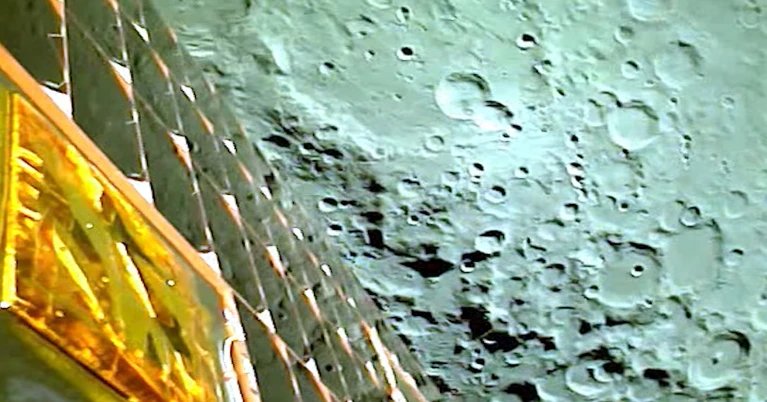
Ahead of Chandrayaan-3’s touchdown, scientists look closely at the smooth, sunlit polar landing site
On 23 August 2023, India’s lunar lander and rover are expected to soft-land somewhere in the Moon’s polar region. As Chandrayaan-3 entered the lunar orbit, scientists are keenly assessing the exact spot, days ahead of the mission’s final descent.
Will the lander Vikram and rover Pragyan land safely? Space watchers are anxious over this question since a glitch had destroyed the lander and rover in India’s second Moon mission four years ago.
Scientists have meticulously chosen a landing spot after screening 20 sites in the polar region. They took care to fine-tune the design of the lander and rover based on learnings from the Chandrayaan-2 mission.
In Ahmedabad, researchers at the Physical Research Laboratory (PRL) and the Space Application Centre, now provide a glimpse of the landing site. They reveal that the site is around 630 kilometres away from the Moon’s south pole. The centre of the landing spot is smooth and has gentle slopes in all directions1.
“It is an illuminated area with a grazing Sun,” said K Durga Prasad, who led the study at the PRL. His team’s study details surface characteristics such as local terrain, illumination, geomorphology, and temperature that Vikram and Pragyan will likely encounter upon landing.
Researchers looked for sites with a slope of less than 10 degrees where more than 90% of the area will remain sunlit for 11 days from the time of the rover’s expected landing. They also ensured the site has boulders no more than two metres in diameter.
Using multiple datasets from the Chandrayaan-1, Chandrayaan-2, SELENE and LRO missions, the scientists zeroed in on 8 spots with boulders less than 0.32m in diameter. They eventually chose a site with a slope of less than 4 degrees. As it is on a high latitude (60˚-70˚), the daytime temperature at this site hovers between 310 – 40 Kelvin.
The Chandrayaan-3 lander and rover will remain active for a single lunar day, which equals 14 Earth days. The rover will roam on lunar soil following the Sun’s movement from east to west, encountering several fresh craters and boulders in its vicinity. The craters and boulders could be its sampling locations. This prior knowledge can assist in planning the rover’s mobility.