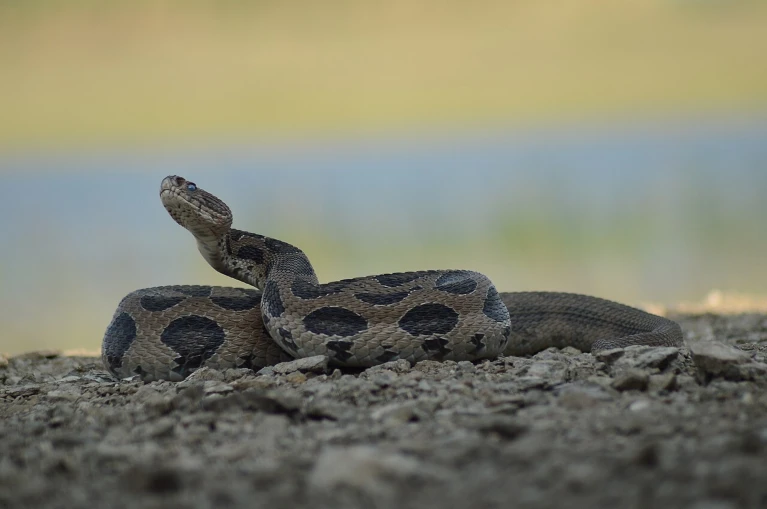
A map of venom types offers hope for regionally targeted therapies
The potency of snake venom lies in its toxic enzymes that have evolved over millions of years through a never-ending battle between snakes and their prey. New research shows climate has a role too1.
Factors such as temperature and rainfall are likely to have influenced the functions of Russell’s viper venoms across various geographical locations in India, the research reveals. This data has been used to create a map of venom types across the snake’s range in India. “It could be used to predict clinical symptoms of snakebites in different regions, informing specific treatments,” says Kartik Sunagar, an evolutionary biologist at the Indian Institute of Science in Bengaluru who led the study.
Snake venom mainly consists of proteins and peptides. Among venomous snakes in India, Russell’s viper causes more than 40% of the snakebite-related deaths each year, triggering different symptoms in different regions.
Sunagar’s team has previously shown that a shift in diet alters the composition and toxicity of Russell’s viper venom from young to adult stages. However, little was known about the roles of environmental factors.
To find out, the researchers analysed venom samples from 115 adult snakes collected from 34 locations across India. They tested the activity of venom toxins, including enzymes that break down phospholipids, proteins and peptides in prey animals, followed by analysis of climate data from 1895 to 2009.
They found a relationship between venom composition and the local climate factors such as temperature and rainfall.
Based on these data, the team developed a model to predict spatial distribution for three key Russell’s viper enzymes – phospholipaseA2 (PLA2), protease and L-amino acid oxidase (LAAO). PLA2 activity, which damages cell membranes, increased across India’s eastern and western coast.
Protease degrades proteins and its activity was highest in the north-western regions. LAAO activity, which disrupts blood clotting, was uniform across the country.
“The research adds to studies that find that climatic variables predict venom composition in snakes and could be used in the future as a means to predict therapies,” says Matthew Holding, an expert on snake venom at the University of Michigan, in the United States.
Next, the researchers found that local climate variables also influenced Russell’s viper venoms’ proteolytic activity that is known to break down the proteins and peptides of prey into amino acids.
The viper venoms’ proteolytic activity was high in the arid and semi-arid regions of north-western India where rainfall is low. However, it decreased southwards along the coast of western India and dropped to a minimum value in the eastern and northeastern parts of the India which are wetter.
The researchers say variations in rainfall and temperature can also indirectly affect venom composition and toxicity by bringing about changes in prey species in a specific region. A recent research, by Holding and his teammates, shows that temperature, coupled with a specific diet, may shape serum protein composition of desert woodrats, allowing them to inhibit the toxic effects of rattlesnake venom2.
“The new study provides us vital leads in venom variability as we search for antivenoms that can be easily stored at room temperature and transported to remote locations,” says Anurag Rathore, who’s engaged in the development of next-generation antivenoms at the Indian Institute of Technology in Delhi.
Sunagar and his colleagues hope the Russell’s viper venom map will advance work on targeted snakebite therapies such as toxin-specific antibodies3.