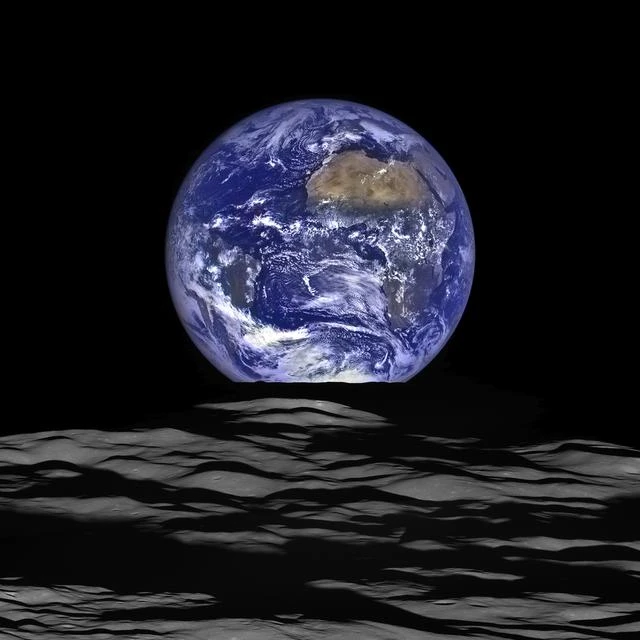
Study shows Earth radiated less heat in a month of 2020, reducing lunar surface temperatures.
Five years ago, the global COVID-19 lockdown briefly halted human activity, triggering a drastic drop in air pollution and temporary banishing of haze.
Clear sky over cities reduced Earth’s ability to trap heat and radiate it back to space, incredibly lowering the Moon’s night-time surface temperatures, new research has shown1.
“This finding opens new possibilities for using the Moon not just for scientific exploration, but as a sensitive detector of Earth’s evolving climate dynamics,” says co-author and physicist, K. Durga Prasad at the Physical Research Laboratory in Ahmedabad, Gujarat.
At an average distance of about 400,000 km, the Moon induces tides on Earth and guides the life cycles of many creatures. The opposite also happens. The Sun heats up the Moon’s thin veil of atmosphere by day, but by night it receives heat only via radiation from Earth that escapes to space and is known as terrestrial radiation (TR).
Previous research has shown that lunar nearside surfaces that always face Earth is sensitive to TR. COVID lockdown led to a reduction in cloud cover and pollutants, decreasing outgoing TR. This prompted Durga Prasad and his colleague, G. Ambily, to investigate further.
They used data from NASA’s Diviner Lunar Radiometer Experiment aboard the Lunar Reconnaissance Orbiter to analyse night-time lunar surface temperatures from 2017 to 2023, before, after and during the lockdown. Their aim was to look for any lockdown-induced subtle signature.
A decrease in the maximum temperature was observed at all sites during the global lockdown period of April 2020 and May 2020. “We observed that night-time temperature was lowered by nearly 8–10 °C,” says Durga Prasad.
The physicists noticed an anomalous dip in the night-time temperatures on all the sites exactly during strict global lockdown period spanning April–May in 2020. All sites recorded a relatively lower temperature range during the strict lockdown than the years between 2017 and 2019 and 2021-2022.
“The data clearly shows the radiation intake by the Moon was less during the lockdown period and its nearside became cooler,” says Sandip Kumar Chakrabarti, an astrophysicist, and director at the Indian Centre for Space Physics in Kolkata, who was not involved in the research.
“The study reinforces that the Earth and the Moon are influencing each other even today, 4.5 billion years after their physical separation since birth,” Chakrabarti adds.
Some experts cast doubt on this discovery. There is a small possibility that radiation from Earth might have a very small effect on the lunar surface temperatures, a separate team reports2. This influence, according to the report, would be so minimal that it would be difficult to measure or even notice.
Durga Prasad, however, notes, the analysis ruled out the effects of solar radiation and its seasonal variations on the Moon’s surface temperatures.